Autism Supports for Air Travel
Airports can be stressful when you are Autistic or have an Autistic family member.
There are a number of disability supports you are entitled to utilize, hiding in plain sight. With a little planning and knowing your options, you can make a travel day go smoother for everyone.
The more I research, the more I realize that Autism support is everywhere, often hiding in plain sight. It used to never occur to me to check in advance to see what accessibility options were available for my Autistic family members, but now that I've had a few experiences with it, I'm looking for them everywhere I go. It takes a little digging to know what's out there, though, so this series, Utilizing Available Resources, is designed to help share what I'm learning along the way with anyone else who may be looking for a cheat sheet. Therefore, I will start by providing a quick resource that you can download or utilize, and THEN go into my personal stories.
The TSA Cares program
The TSA Cares program is a fantastic resource designed to reduce the stress of security screening for travelers with disabilities, including those with Autism. It provides more than just information; it offers personalized, hands-on support through the checkpoint.
Here is how you can effectively utilize it for your family:
How to Set Up Assistance
To ensure a Passenger Support Specialist (PSS) is available to meet you, you must make a request in advance:
Timing: Submit your request at least 72 hours before your flight. If it’s less than 72 hours, you may still be able to get a dedicated TSA agent, but it’s less guaranteed.
Method:
Online: Fill out theTSA Cares assistance form on the TSA website.
Phone: Call (855) 787-2227. *When I called, there was ZERO wait time.
What to provide: Have your flight details (airline, flight number, time) ready. Mention that you are traveling with an autistic family member and specify if they have sensitivities to touch, noise, or crowds.
TSA Cares: What to Expect at the Airport
Before you arrive: You will receive a text message with a phone number you can call at the airport to let them know you have arrived and have requested a PSS. They asked us to provide a description of our group, and gave us instructions on where to go in the TSA line to meet them.
The Meeting: Depending on the airport, a specialist may meet you at the ticket counter or a designated spot. They often help you bypass the standard long lines to avoid the "waiting anxiety" that can trigger meltdowns.
* Our experience: the PSS cheerfully met us and introduced herself. She asked in advance what she should know about how to best help my brother. I explained that while my brother is brilliant, he is nonverbal when anxious and requires extra auditory processing and response time, but that he understands everything she is saying. She adjusted her approach to him based on that information.
The Screening: They can facilitate "modified screening." For example, family members can often stay together throughout the process, and you can keep comfort items (such as weighted blankets or sensory toys) close by. You can also request a “private screening” in a separate room, if that best fits your needs.
The Specialist: They act as an advocate and a buffer, ensuring the TSA officers on duty understand your family's specific needs so no one is surprised by a sudden movement or vocalization.
*Our experience: Our PSS took our IDs in advance and walked us through the ropes and straight to the ID checkpoint like we were celebrities shutting down Disneyland for the day. She gave clear, paced instructions to help my brother get his bag and electronics through security. The area after the screening and X-ray machines was quite tight. She guided us to a separate table away from the line and retrieved our items so we didn’t have to be in close proximity to others, and my brother was able to rearrange his things without the pressure of a line behind him. She then escorted us to the gate, identifying food and coffee options and the location of the closest bathrooms.
Pro-Tips for a Smoother Experience
TSA Notification Card: Even if you use TSA Cares, print out aTSA Notification Card. You can hand this to an officer to discreetly communicate a diagnosis without speaking about it loudly in public.
Sunflower Lanyard: Many airports now recognize the Hidden Disabilities Sunflower lanyard. Wearing one is a universal sign to airport staff that your family might need a little more time or patience.
Wings for Autism: Check if your local airport participates in "Wings for Autism" or similar events. These are "rehearsal" days when families can practice the entire airport process—from check-in to boarding a plane—without actually taking flight.

What if I can’t call in advance?
Request a Specialist at the Checkpoint
If you couldn't call or didn't get a confirmation, you can request a Passenger Support Specialist (PSS) in person.
The Process: As soon as you arrive at the security checkpoint, look for a TSA supervisor or officer at the start of the line.
What to Say: "I am traveling with a family member who is autistic. Can we please have a Passenger Support Specialist assist us through screening?"
Availability: Most medium and large airports have several PSS officers on duty at all times. They are trained specifically to handle sensory sensitivities and can help you navigate the process without the standard "rush."
2. Use Your "Backup" Tools
Since you won't have a pre-arranged meeting, these visual cues become much more important for quick communication with busy officers:
The TSA Notification Card: If you haven't printed one, you can quickly write "Autism - Sensory Sensitive" on a piece of paper. Handing this to the first officer you see allows them to process the situation without you having to explain it verbally in front of your family member (which can sometimes cause anxiety).
Ask for "Modified Screening": You have the right to ask for screening that doesn't involve separating your family. You can also request a private screening if the noise and lights of the main area are becoming a trigger.
3. Head to the "Family" or "Assistance" Lane
If the airport has a dedicated lane for families or travelers with disabilities, head there first. The officers staffing these lanes are generally accustomed to a slower pace and are more likely to be (or have quick access to) a Passenger Support Specialist.
Other Autism Airport Supports for a Smooth Trip:
Gate Passes, DPNA Code, Priority Boarding, and more.
A gate pass
Even if you are not traveling with your Autistic family member, there are some steps you can take to reduce stress and pressure on them. Under the Air Carrier Access Act (ACAA) and TSA guidelines, "non-passenger escorts" (gate passes) are a recognized accommodation for people with disabilities.
How to request one:
Airlines are technically the ones who issue the gate pass, not the TSA. Per the policy used by major carriers (and even smaller ones like Breeze or Allegiant), a gate pass can be issued to:
An escort for a passenger with a disability (to the gate).
Someone meeting a passenger with a disability (at the gate).
Whether you are checking a bag or not, go to your airline's baggage area. Let the staff there know that you have an Autistic family member who requires a familiar person to accompany them to the gate and get them onto the plane.
They will look up the passenger information, request your ID, and book you a gate pass. You can now stay with your family member until they board the plane.
*Our experience: Our first time doing this, my family member was flying Breeze Airways. We went to the baggage drop-off, and I talked to the gate agent, and it all went smoothly. She even added notes for the crew and, later at the gate, allowed us to skip the queue to board the plane. However, when he was picked up at the airport, they refused to give my mother a gate pass and said they would send someone to pick him up, which they never did. More on what to do if they try that later.
The "DPNA" Code
When booking your airline tickets, ask the airline to add a DPNA (Disabled Passenger with Intellectual or Developmental Disability Needing Assistance) code to your reservation. This alerts the airline crew to provide extra support at the gate and on the plane. Many of the larger airlines offer customer support via text message, so you don’t even necessarily need to gear up for the stress of a customer service phone call.
Priority Boarding
Like families with small children and wheelchair users, your loved one has a right to utilize priority boarding. It’s for people who need extra time settling in, yes, but it’s also for people with Autism and other special needs. Talk to the gate agent before boarding about receiving this accommodation.
Sensory rooms
Several major airports have recognized the need for quiet, controlled environments to help neurodivergent travelers and their families decompress. See my comprehensive resource for Airport Sensory rooms, or check your airport map to see if there is one near your gate. You can also use meditation rooms and chapels, where available, for a quieter space if needed.
Meeting the Pilot
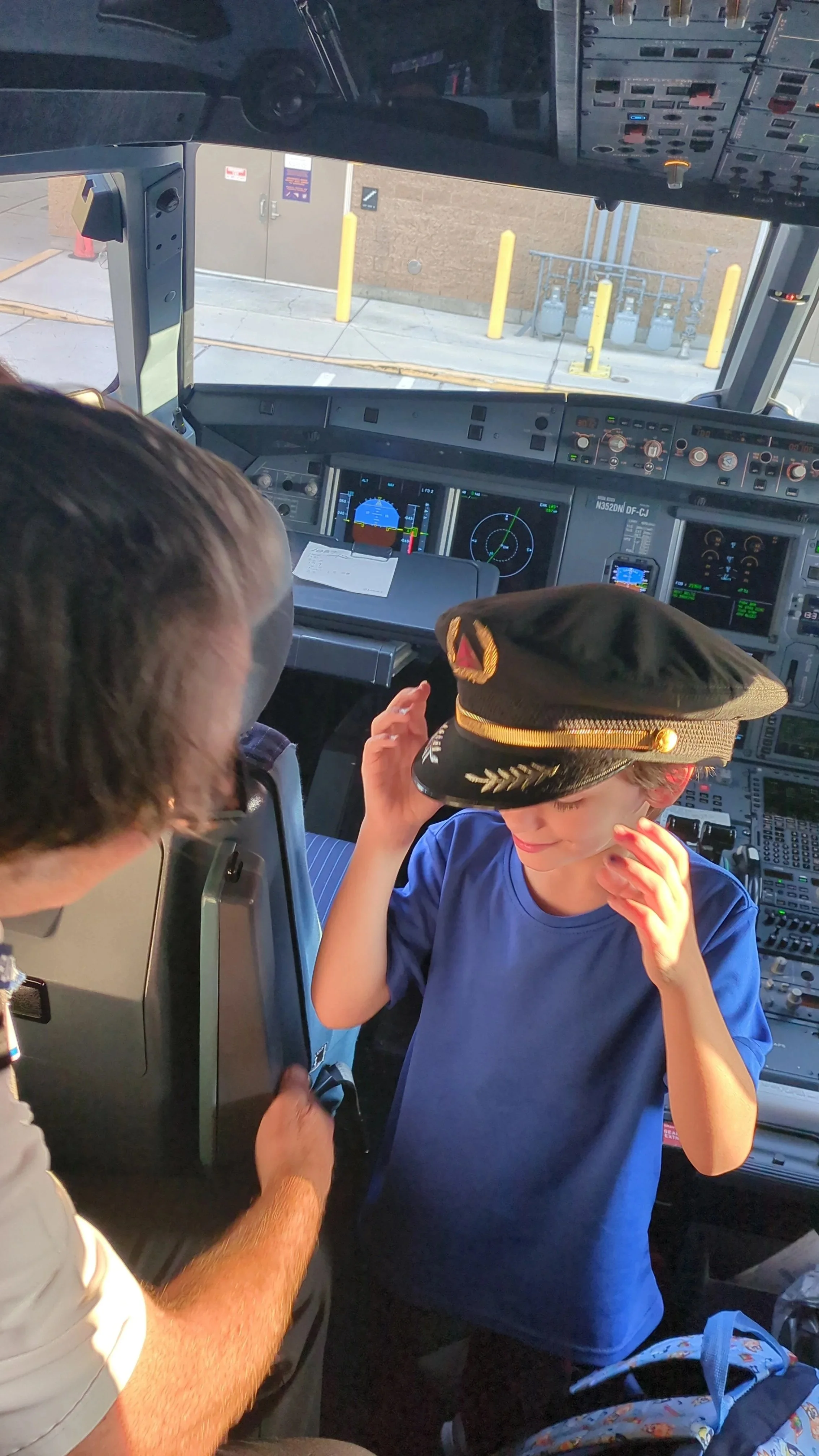
While more commonly done for young children to help them feel comfortable on a plane, you can always ask for a visit to the cockpit for your loved one if it will help them feel more comfortable. Depending on the conditions and the needs of the plane, they may refuse. This is an optional service, so if they say no, or “not right now,” that’s ok.
Social Stories
Airports are, in general, quite routine and predictable, something that can be of great benefit if you are Autistic. There are lots of Social Stories, either for e-readers or on youtube, that can help prepare your loved one for the steps of getting through an airport. Here are a few youtube videos I like:
Kid’s First Flight From the FAA
How Airplanes Fly (the science can help anxiety)
What are my rights, and what do I do if an employee refuses?
Pushing back when you aren't getting the accommodations you are entitled to can be intimidating, but there is a specific hierarchy of authority you can invoke to get results in real time.
1. Request a Supervisor or PSS (TSA Checkpoint)
If the TSA officer at the line is dismissive of your request for assistance or a private screening, use the "Magic Words" immediately:
"I would like to speak with a Passenger Support Specialist (PSS) or a Supervisor."
Why: Every airport has trained PSS officers specifically for these situations. Standard officers may be focused solely on throughput; the PSS is trained on the legal requirements of the TSA Cares program.
You can say: "Under the Airline Passengers with Disabilities Bill of Rights, I am entitled to assistance that accommodates my family member's neurodivergence. How can we make this work for their safety?”
2. Trigger the "CRO" (Gate/Airline Issues)
If the issue is with a Gate Pass or boarding assistance (which is handled by the airline, not TSA), standard gate agents may tell you, "We don't do that."
The "Employee Escort" Loophole: Some airlines try to meet the "assistance" requirement by assigning a staff member to walk the passenger to the gate or baggage claim.
While legal, it doesn't account for the specific sensory or emotional needs of an autistic person who may need a familiar face to prevent a meltdown or elopement.
Clarify: "A stranger's assistance will not meet the accommodation requirements for their disability, and may cause a _________ (meltdown, safety, or elopement risk). For their safety and the safety of airport staff, they need a familiar person to meet them at the gate to feel secure."
The Pushback: If they refuse, say, "I would like to speak with your Complaint Resolution Official (CRO) regarding an accommodation under the Air Carrier Access Act (ACAA)."
Why: By federal law, every airline must have a CRO available (even if just by phone) during operating hours. They are the only ones with the specific authority to resolve disability-related disputes on the spot. Mentioning the "ACAA" shows you know your legal rights. Often, just asking for this will make them decide it’s not worth the hassle, and they will honor your rights.
They may bring in a supervisor. Ask, “Are you the official CRO on duty?” If they say no and are not willing to accommodate your disability request, remind them that you have the right to speak to a CRO and request that they continue to escalate your concern. You can say: "Under the Airline Passengers with Disabilities Bill of Rights, I am entitled to assistance that accommodates my family member's neurodivergence. How can we make this work for their safety?
What to Do If You Can't Resolve It on the Spot
If the travel day ends and you feel your rights were violated, do not let it go. Filing a formal complaint helps ensure that the specific airport or airline receives the training they clearly lack.
Where to File Complaints
TSA/Security
TSA Multicultural Branch
Online Civil Rights Complaint Form
Airline/Gate Pass
DOT Aviation Consumer Protection
You can also make a complaint directly to your airline.
Make a paper trail
Whenever you have to push back, try to discreetly note:
The Name/Badge Number of the employee.
The Time and Location (e.g., Gate 14 or Checkpoint 3).
The specific reason given for the denial (e.g., "We don't have enough staff").
This information is crucial for a DOT or TSA complaint. It moves your report from "an unhappy passenger" to "a documented violation of federal law."
Remember - if you do have any issues and feel like it isn’t worth it to push back or file a complaint, your experience is not just about you. We live in a world where many people wish disabled people would just go away, be invisible, or not be an inconvenience to them, and our kids deserve better than that. For every mama bear that has the bandwidth to read this blog and stay loud when they want us to be quiet, there are a hundred parents and disabled kids who don’t have the resources to fight back. When you push back for your kid, you are pushing back for ALL kids.